
September Nature News
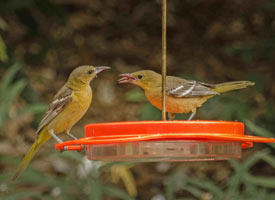 Orioles - bid farewell! Local photo by Susie Kelly |
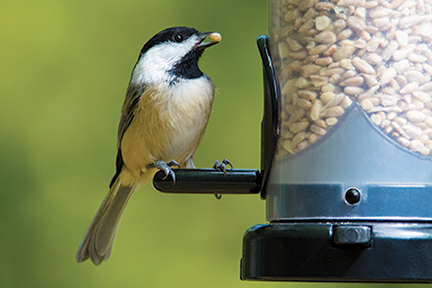
While July and August saw the earlier stages of migration as arctic-nesting shorebirds made their way south, September is when we really notice movement across many different groups of birds, including the smaller songbirds most visible in our yards. The next few weeks will see more or less the last of most summer birds such as orioles, grosbeaks, tanagers, and certain warbler species. Many of these birds migrate south during the night and eat voraciously during the day, often associating with resident chickadees, bushtits, and titmice in our local woodlands. In general, many of the songbirds that spend their summers here are insect-eaters and will not be drawn to feeders, but some may visit birdbaths, eat fresh berries and fruit, or be seen hunting insects right in your yard. There are a few, such as orioles, rufous hummingbirds, and black-headed grosbeaks, who will stop at jelly, nectar, and seed feeders respectively. Keep your eyes open for unexpected passers-by!
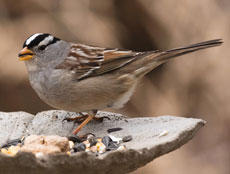
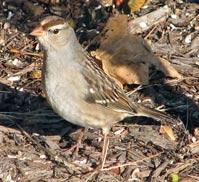
But as far as backyard observation goes, September is more likely to be noticed for the arrival of our first winter birds. While summer hosted more insect-eating species, winter draws a notable collection of seed-eating birds that will readily visit feeders. Migratory pine siskins may join the resident house finches and goldfinches who gather in winter flocks and focus their attention on seeding plants and feeders. (September is when we start seeing activity on Nyjer feeders start picking up after the summer lull.) But most noticeable of all, or unmissable really, are the white-crowned and golden-crowned sparrows that appear in the second half of September and become ubiquitous in October. These two species are the most common of a winter sparrow crowd that also includes the less common white-throated sparrow, fox sparrow, and Lincoln’s sparrow.
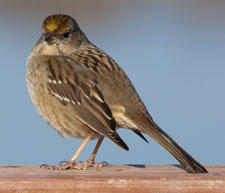 Golden-crowned Sparrow Golden-crowned Sparrow |
What are sparrows anyways? The word is sometimes grasped at by non-birdwatchers as a familiar-sounding term for smallish, dull-colored birds. There is some truth to this, but several of our sparrows are quite prominently colored and none of our common species present any major difficulties in identification. These winter birds we’re talking about are all somewhat chunky little birds a little bigger than our common year-round house finches, with wide conical bills good for cracking open seed shells, and generally sharing a preference for feeding on the ground, where they scratch around in the understory and dirt for fallen seeds. If you learn these three pictures, all of which you are certain to see in real life in the next few months, you’ll be ready for 90%+ of our winter sparrows.
|
Adult White-crowned Sparrow |
First Winter White-crowned Sparrow |
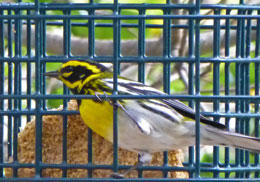 Townsend's warbler Townsend's warbler Local photo by Theresa Fisher |
There are some insect-eating songbirds arriving in the next few weeks, as well, including Townsend’s and yellow-rumped warblers, both of which can be drawn to suet or mealworm feeders. Hermit thrushes, found only in forests in summer, disperse quietly through many residential areas to feed on insects and berries. And there are two other notable winter berry-lovers, robins and cedar waxwings, who fly in flocks to feed on both native, fall-fruiting plants like madrone and toyon as well as suburban ornamentals like Chinese pistache and pyracantha. For just about all of these birds, September is the cusp of the winter season with the first migrants appearing this month, soon to be followed by many more of their kind in October.
Beyond the yard, there’s a lot going on as the better part of the migratory bird world streams southward. Thousands of hawks, peregrine falcons, merlins, and other birds of prey are funnelled through Marin and over the Golden Gate where they can be observed at Hawk Hill in the Marin Headlands. Keep up with migration with the daily reports from our friends at the Golden Gate Raptor Observatory and make a visit in late September or early October to see the peak of hawk migration when hundreds of raptors will pass by each day.
 The view from Hawk Hill The view from Hawk Hill |
Another one of our favorite fall migration events is a trip to McNear's Brickyard in San Rafael, where the old chimneys host thousands of Vaux’s swifts seeking a roosting spot for the night. Visit at sunset in mid- to late-September and you might see thousands of swifts congregating in a swirling vortex over the rooftops before diving into the stacks. Shorebirds continue to increase in Bay Area wetlands (see Hamilton, Rush Creek, Shollenberger) and the latter part of September will see the beginning of the major winter waterfowl season, as large groups of ducks arrive from their northern breeding grounds.